 Cold-
00 // First cut
- “Crypto is buying Congress.” Both parties get the money, but not equally, and a third of it went into one Ohio Senate race.
- The AI industry is fighting itself. Two networks on opposite sides spent $23 million on one House primary in Manhattan.
- “A handful of billionaires.” Inside these super PACs, it’s literal. Three donors gave 98% of the donations to the crypto super PAC.
- Does money win? Incumbents almost always do. This year’s races point both ways.
- “The most expensive midterm ever.” It’s a forecast of ad spending, and it still beats 2022 after inflation.
- What’s at stake. The 2027 deadlines waiting for the next Congress, and the industries they hit.
- Last month’s board. What moved since October.
The key numbers carry a tag.
- Verified checked in the linked official source (not audited by us)
- Reported news coverage or someone else’s figure we haven’t matched to an official document
- Estimated our own math from the filings and official data, through reports covering October 14 (the AI comparison runs through September 30)
The midterms are Tuesday, and you’ve probably seen the headlines. Crypto is buying Congress. A handful of billionaires are buying the election. This is the most expensive midterm ever.
We’re a markets newsletter, so here’s why we care. The industries writing the biggest checks are the ones whose rules the next Congress will write, and you might own their stocks. So we went to the filings to see who’s paying, who it’s helping, and what they’re after. Some of the headlines hold up and some don’t. Here’s which is which.
“Crypto is buying Congress”
So, is it? Here’s what the filings show.
The crypto industry’s main super PAC is Fairshake. It works with two sister super PACs, Defend American Jobs, which mostly backs Republicans, and Protect Progress, which mostly backs Democrats. Together they’ve spent $137 million this midterm on ads for and against candidates. Estimated Fairshake ↗ Defend American Jobs ↗ Protect Progress ↗
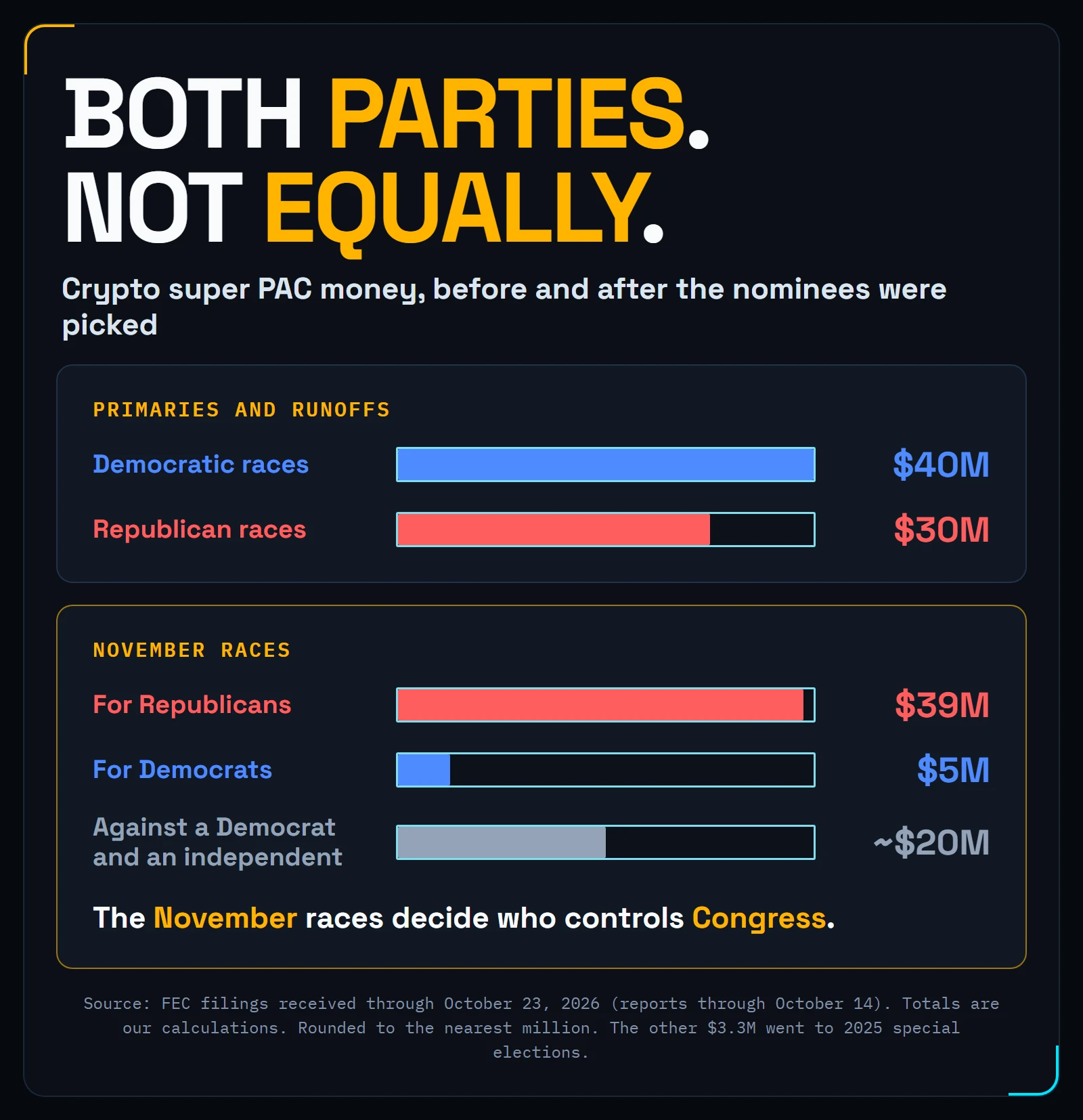
Both parties get money. Not equally, and not at the same time.
In the primaries and runoffs, before the nominees were picked, the money went to both parties. About $40 million went into Democratic races and $30 million into Republican ones.
In the November races, the ones that decide who controls Congress, it flips. About $39 million is backing Republicans and $5 million is backing Democrats, and close to $20 million is going against a Democrat and an independent. Estimated (The other $3.3 million went into 2025 special elections.)
One race got a third of all of it
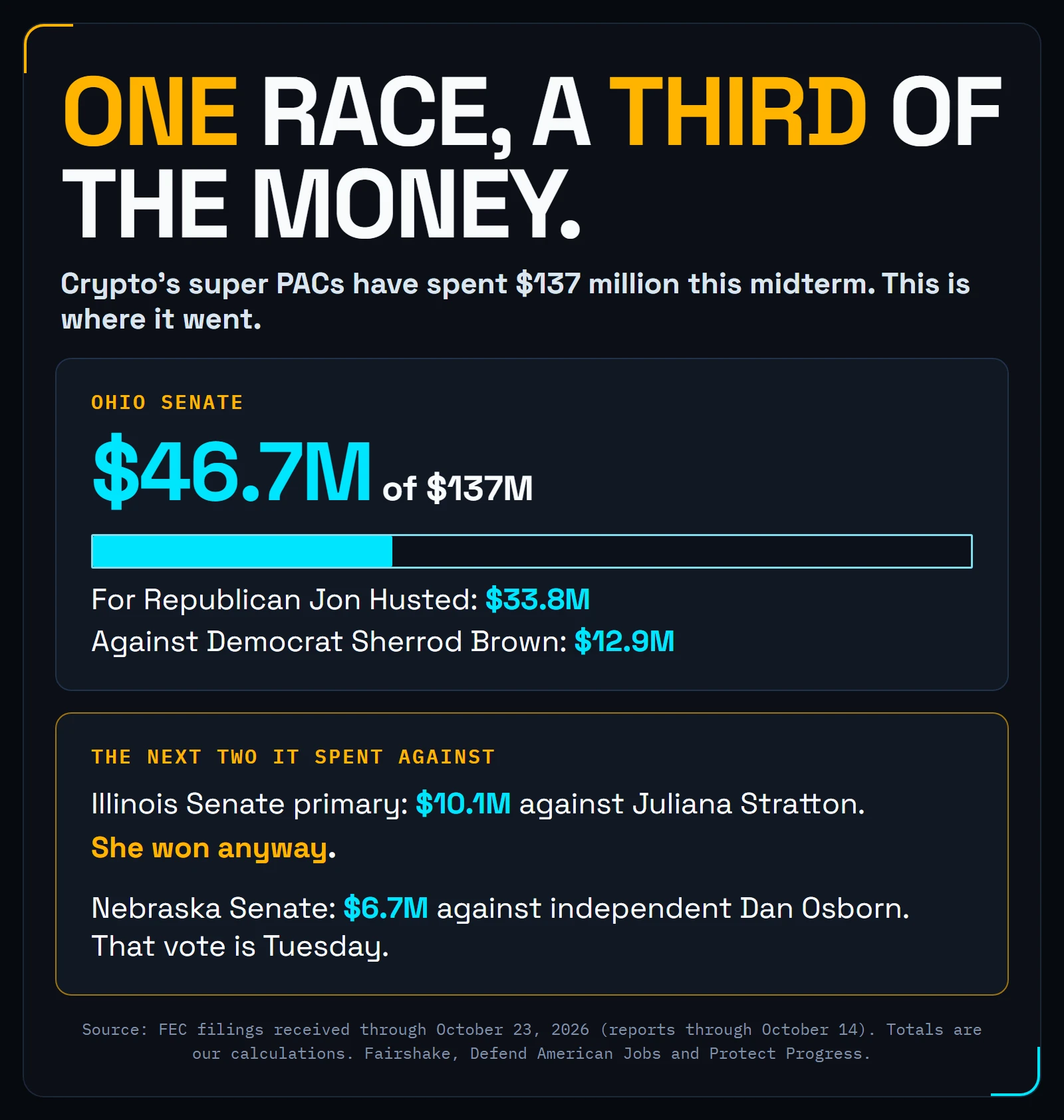
$46.7 million went into Ohio’s Senate race, with $33.8 million for Republican Jon Husted and $12.9 million against Democrat Sherrod Brown. Estimated Fairshake said in September it would spend $30 million against Brown. Reported Cointelegraph ↗
Why Brown? He used to chair the Senate Banking Committee, where crypto’s rules get written, and he was one of the industry’s loudest critics in Congress. Fairshake spent about $40 million against him in 2024 too, the year he lost his seat. Now he’s running to get back in. Reported TNND ↗
The money doesn’t always win
The second-biggest target was Illinois’s Democratic Senate primary in March, with $10.1 million spent against Lieutenant Governor Juliana Stratton, who is now running for Senate. Estimated The industry backed her opponent, Rep. Raja Krishnamoorthi. She won anyway, and in the blue state of Illinois, the Democratic primary usually determines who will be the next Illinois senator. Reported DL News ↗
The other big target is in November. $6.7 million is going against Dan Osborn, the independent challenging Republican Sen. Pete Ricketts in Nebraska. Estimated Coverage of those ads is thin, and we haven’t found the industry saying why it picked Osborn.
So which Democrats got the help?
First, how this works. A super PAC can’t hand a candidate money. It runs its own ads, so nobody here cashed a check, but they still get the help. The biggest Democratic beneficiaries were all in primaries. Christian Menefee in Texas got $6.5 million, Adrian Boafo in Maryland $5.3 million and Jasmine Clark in Georgia $4.2 million. Estimated
And the ads didn’t have to be about crypto. Forbes reported that Boafo’s never mentioned it, and when Axios reviewed the industry’s 2024 ads it found no mention of crypto in any of them. Reported Forbes ↗ Axios ↗
Why both parties? Follow the bill.
Crypto’s big ask in Washington is a law called the CLARITY Act, which sets the rules for who oversees crypto trading and how. It passed the House in July 2025. Verified House vote ↗ It cleared the Senate Banking Committee in May. Reported Decrypt ↗ Then it stalled. On September 15 the Senate voted 49 to 50 on whether to take it up, 11 short of the 60 it needed. Verified Senate vote ↗ No Democrat voted yes, and four Republicans voted no (one so the bill could be brought back). Reported The Defiant ↗ As of now, Republicans hold 53 seats, so reviving it takes at least seven votes from outside the Republican caucus.
We can’t see inside anyone’s head, but the math lines up. When you need seven votes from the other party, picking which Democrats make the ballot matters as much as electing Republicans.
If you own crypto, or shares of companies that trade it or hold it, that bill’s rules are what’s at stake for you.
Ohio. It’s the single biggest bet the industry made this year.
“AI money is flooding the midterms”
The AI industry copied crypto’s playbook, with one twist. It’s fighting itself.
- Leading the Future is backed by OpenAI’s president, Greg Brockman, and the venture firm Andreessen Horowitz. It wants one national set of AI rules in place of the states’ rules. Reported Gizmodo ↗
- Public First is funded mostly through a nonprofit that Anthropic says it donated to. It backs candidates who want stricter AI rules. Reported Axios ↗
Through September 30, Leading the Future’s network took in $78 million and Public First’s took in $30 million. Estimated Crypto’s network alone took in more than both put together. Leading the Future ↗ Public First ↗ Jobs and Democracy PAC ↗ Defending Our Values PAC ↗
Where they collided
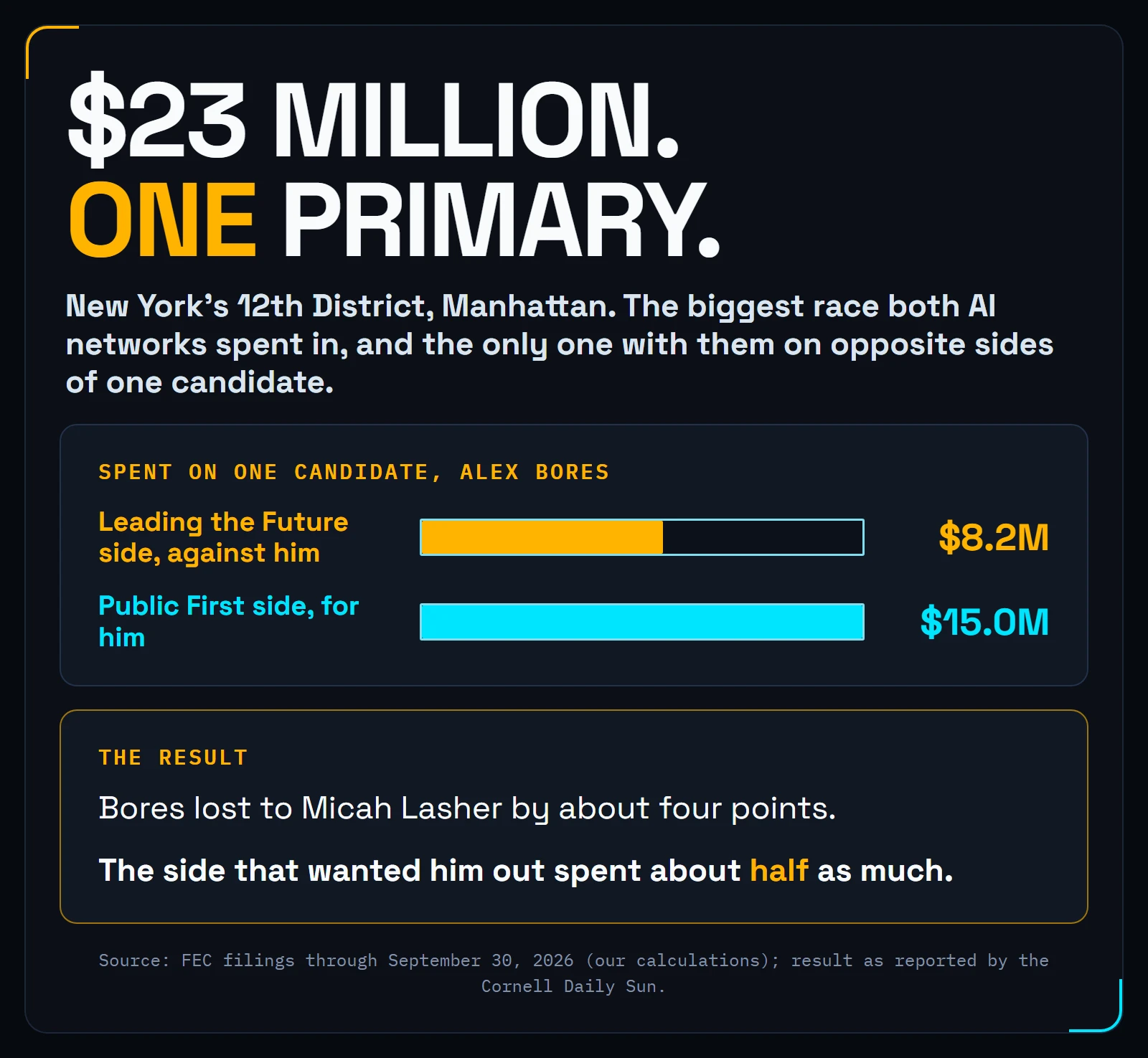
The biggest race both networks spent in, and the only one where they were on opposite sides of the same candidate, was the Democratic primary in New York’s 12th District, in Manhattan. It came down to one candidate, Alex Bores, the state lawmaker who wrote New York’s AI safety law. Leading the Future’s side spent $8.2 million against him, and Public First’s side spent $15.0 million for him. Estimated That’s about $23 million on one House primary.
Bores lost to Micah Lasher by about four points. Reported Cornell Daily Sun ↗ So the side that wanted him out got its way, and it spent about half as much.
Both sides, both parties
Neither network sticks to one party. Leading the Future put more behind Republicans ($13.4 million) than Democrats ($8.9 million), and all the money it spent against anyone went after Bores. Public First put more behind Democrats ($17.5 million, most of it for Bores) than Republicans ($6.5 million), and spent $0.8 million against Republicans. Estimated It’s the same math as crypto. Whichever way the AI rules go, they’ll need votes from both parties.
Where the trail ends
Leading the Future’s donations trace back to six donors (section 03). Public First’s mostly doesn’t. About $24 million of it came from the nonprofit, Public First Action, and nonprofits like that generally don’t have to name their donors. Estimated Anthropic says the money it gave that nonprofit was restricted to public education and policy work, not elections. Reported Feb ↗ Jul ↗ That’s Anthropic’s own account. What the filings show is the nonprofit’s roughly $24 million going into Public First’s super PACs, and about $4.3 million more in direct gifts. One of them is from Anthropic’s CEO, Dario Amodei, who gave $1 million himself. Verified Filing ↗ Bloomberg Law ↗
Those are the major donors we found in the public filings, and every one of them is in this issue.
Whether AI gets one national rulebook or fifty state ones is a real cost question for the companies building it, and they’re a big piece of most stock portfolios. Last month’s issue followed their spending. This is their politics.
“A handful of billionaires are buying the election”
You’ve seen the leaderboards. A progressive advocacy group counts hundreds of millions from billionaires this cycle, most of it to one party. Reported Common Dreams ↗ Here’s who funds the super PACs in this issue, straight from their filings, and “a handful” is literal.
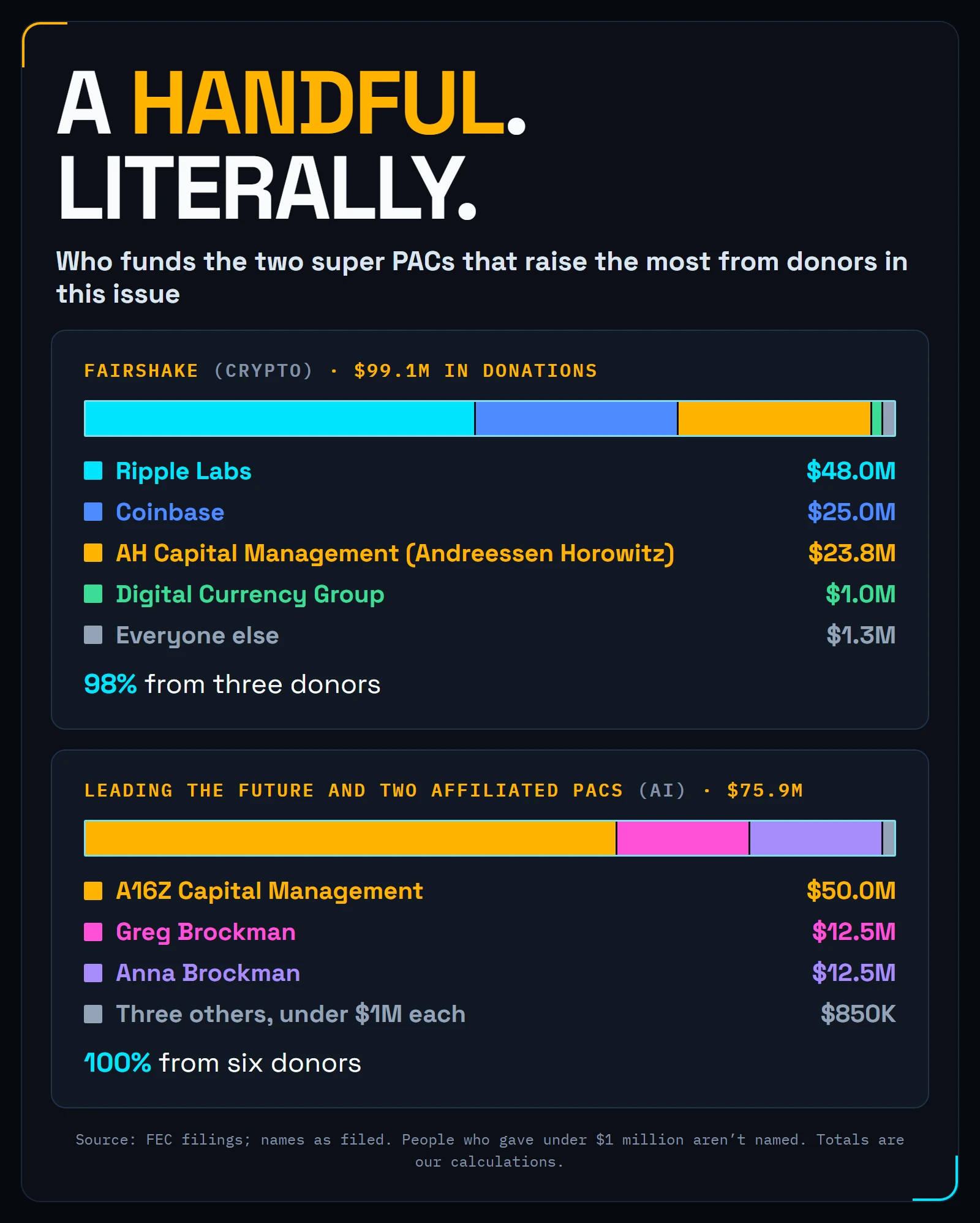
- Fairshake. Three donors gave $96.8 million of the $99.1 million it received from donors, a whopping 98% of the total. Estimated They’re Ripple Labs ($48 million), Coinbase ($25 million) and AH Capital Management ($23.8 million). Estimated Filing ↗ Filing ↗ The next biggest is Digital Currency Group ($1 million). Verified Filing ↗ AH Capital Management is Andreessen Horowitz. Reported FactCheck.org ↗
- Leading the Future. Six donors gave all $75.9 million in donations to Leading the Future and its two affiliated PACs, three companies and three individuals. Estimated The biggest is Andreessen Horowitz’s A16Z Capital Management ($50 million), then Greg Brockman and Anna Brockman ($12.5 million each). The other three gave less than $1 million each: two companies ($250,000 and $100,000) and one individual ($500,000). Estimated Filing ↗ Filing ↗
- Public First. Most of its money came from its nonprofit, Public First Action, about $24 million, and we didn’t find the nonprofit’s own donor list in any source we reviewed. Estimated About $4.3 million more came directly from donors. The largest are Dario Amodei ($1 million) Verified Filing ↗ and two filings under the name Peter Lofgren ($999,900 and $5,000). Estimated Filing ↗ Filing ↗
So Andreessen Horowitz is on both lists, about $74 million between crypto and AI. Estimated
How we name them. Companies and people who gave $1 million or more are named, by the name on the filing. Those who gave less stay unnamed. Same rule for every super PAC here. A name on a filing tells you who wrote the check, not who owns the company or whose money it was.
Why the checks can be this big
Super PACs are only about 16 years old. In 2010 the Supreme Court’s Citizens United decision said corporations could spend unlimited money on their own political ads, as long as they didn’t coordinate with a campaign. A few months later a federal appeals court applied the same logic in a case called SpeechNow, and groups that only run their own ads could suddenly take unlimited contributions. Those groups are super PACs. Verified FEC, Citizens United ↗ FEC, SpeechNow ↗
The old-style industry PACs still work the other way, with limited checks that go straight to candidates. For scale, the two we checked, for the securities industry and the electric utilities, each took in under $1 million. Estimated Securities ↗ Utilities ↗
When three donors fund almost an entire super PAC, it’s worth knowing who they are. The filings don’t show who decides where the money goes, but they do show how short the list is.
“Money wins elections”
The argument goes like this. Incumbents out-raise challengers by a mile, and they almost always win, so money must be what wins.
Half of that is true. House incumbents who made the ballot won 97.5% of the time in 2022, 356 of 365. Estimated (our count from the FEC’s official results) FEC, 2022 ↗
But incumbents also have their name on the door, a district drawn to suit them and a head start on everything. A count of who won can’t pull the money apart from all of those added incumbent advantages.
And this year’s races point both ways. Brown lost his seat in 2024 after about $40 million was spent against him, and beating a sitting senator is hard. But Stratton won in Illinois with $10 million against her, and Bores lost with $15 million behind him.
356 of 365. That’s 177 of 183 Democrats and 179 of 182 Republicans. Estimated
All 172 incumbents on the Democratic line won. A bad year for one party sinks incumbents who usually win. Estimated FEC, 2018 ↗
Whether 2026 looks more like 2022 or 2018. And whether $46.7 million is enough in Ohio.
“The most expensive midterm ever”
The number going around is $11.6 billion in political ads this year, up from $8.9 billion in 2022. Reported TV Technology ↗
Two things to know about it. It’s a forecast, made by an ad-tracking firm before the election is over. And it counts ads only, including state and local races.
Does it hold up after inflation? Yes. 2022’s $8.9 billion is about $10.1 billion in today’s dollars, so the forecast still beats it. Estimated (with the BLS consumer price index) BLS ↗ Whether all spending, not just ads, sets a record, nobody can say until the final reports are in.
What the next Congress inherits
Whoever wins Tuesday walks into deadlines that land on specific industries. Each one is set in current law or an official projection. Verified
- 2027 · no exact dateThe debt limit
The Congressional Budget Office expects the $41.1 trillion limit to be reached sometime in 2027. That isn’t the day the money runs out, because the Treasury has emergency measures after that. It’s the bond market’s date to watch. CBO ↗
- Sept 30, 2027Drug and device review fees
The fees that pay for the FDA’s reviews of new drugs, generics, biosimilars and medical devices expire unless Congress renews them. That’s every drug and device maker’s pipeline. Devices ↗ Drugs ↗ Generics ↗ Biosimilars ↗
- Dec 31, 2027Wind and solar tax credits
For projects that started construction after July 4, 2026, the main credits end for anything not running by the end of 2027 (with exceptions). That’s the wind and solar industry’s deadline. IRS ↗
- Dec 31, 2027Terrorism insurance backstop
The federal backstop behind terrorism coverage ends. That matters to insurers and to big commercial buildings that need the coverage. Treasury ↗
On your ballot, maybe
A few states vote Tuesday on measures that hit wallets directly. California has a one-time wealth tax (Proposition 40), Washington a repeal of its planned 2028 income tax, Colorado a 4.4% cap on its income-tax rate (it’s already 4.4%), and Arizona a ban on mileage-based driving fees (with exceptions). Each applies only if it passes. Verified California ↗ Washington ↗ Colorado ↗ Arizona ↗
What we couldn’t pin down
We’d rather tell you what we couldn’t confirm than round it up into a headline.
- The whole industry. We followed one crypto network and two AI networks, not every crypto or AI dollar, and not each party’s national total.
- Who’s behind the donors. A company that gives is reported as the company. Who owns or funds it isn’t in the filings, and we didn’t find the nonprofit’s donor list in any source we reviewed.
- Quick notices. We used the regular reports. A handful of the fast 24-hour notices label spending differently (for or against), and we didn’t try to settle those. In Public First’s network, $9,000 of in-kind transfers couldn’t be matched.
- What the ads said. The filings show who paid and which candidate each ad was for or against, not what was on screen.
- Whether money causes wins. Counts like these can’t answer that.
Last month’s board: what moved
Last month we started tracking ten things about the AI build-out and promised to show you what moved. Here it is.
Over the twelve months through September, Amazon’s operations brought in $168.3 billion. Free cash flow, as Amazon defines it, was negative $42.4 billion, against positive $14.8 billion a year earlier. In the third quarter alone it spent $77.3 billion on property and equipment and took in $48.1 billion of new long-term debt. Its long-term debt has gone from $65.6 billion at the end of 2025 to $173.1 billion. Verified Amazon’s Q3 release ↗ Amazon expects to spend about $220 billion this year, and so far this year it has taken in $115.1 billion of new long-term debt.
- Moved
- Waiting on a report
- No change
01 // Cash and funding
October · Alphabet’s Q2 free cash flow went below zero.
Amazon’s was already below zero over the twelve months through June (negative $7.6 billion). Through September it’s negative $42.4 billion (above). Alphabet’s third-quarter free cash flow was negative $9.07 billion, deeper than the second quarter’s negative $5.86 billion, and in the same quarter it raised $28.7 billion in new bonds and $12.4 billion selling new shares. Verified Alphabet’s Q3 release ↗ Meta’s went below zero for the quarter, negative $2.12 billion against positive $10.63 billion a year earlier. Verified Meta’s Q3 release ↗
02 // Spending plans
October · Meta raised the low end of its 2026 range to $130 billion.
Meta narrowed its guidance again, to $135 to $145 billion. That’s guidance, not money spent. Verified Meta’s Q3 release ↗
03 // Cloud growth vs. spending
October · Not assessed.
Google Cloud’s revenue grew 103% to $30.7 billion, while Alphabet spent $51.4 billion on property and equipment. Microsoft’s Azure grew 48%, and Microsoft spent $39.4 billion. Amazon’s AWS grew 39% to $46.0 billion, and Amazon spent $77.3 billion. Verified Alphabet’s Q3 release ↗ Microsoft’s Q1 release ↗ Amazon’s Q3 release ↗ That spending covers more than the cloud business.
04 // Accounting
October · Awaiting Microsoft’s filing on its building-life change.
The filing is out, and it doesn’t set out the change. Microsoft said in July it would count its data centers and offices as lasting 25 years instead of 15. Reported DCD ↗ Its quarterly report, filed October 28, has no note describing it. Depreciation was $11.1 billion, up from $7.1 billion a year earlier. Verified 10-Q ↗ So we still can’t confirm the change or its effect from a filing.
05 // Fund withdrawals
October · BCRED’s Q2 buyback filled about half.
New to the board (filed September 30): an outside fund offered to buy up to $20 million of BCRED’s Class I shares at a 12.5% discount ($20.65 against the published August 31 value of $23.60). BCRED’s board told shareholders to reject it. Verified 8-K ↗
Why it’s worth a look. When investors can’t get all their money out the front door, a buyer can show up at the back door with cash at a discount. Whether anyone took it isn’t in the filing.
06 // Loan quality
October · Not assessed.
Still not assessed. That’s a gap, not an all-clear.
07 // Private-credit defaults
October · No current comparison.
No verified update.
08 // Bank lending
October · Awaiting the Fed’s November survey.
Due Monday, Nov 2, after this issue.
09 // Memory chips
October · HBM4 in volume production.
No verified update.
10 // Permission to build
October · Pauses in New York, Texas and Oregon. New York’s bill unsigned.
The official record still shows no delivery of New York’s bill to the governor. Verified Bill ↗ Oregon’s governor asked for data-center air and water permits to be paused until July 2027, and one host city’s council voted to declare an emergency over the threatened financial loss. Reported Washington State Standard ↗ No verified update from Texas.
So that’s where the money is, as far as the filings go. Crypto made its biggest bet on one Senate race in Ohio. The AI networks’ biggest fight was one House primary in Manhattan. And the money didn’t win every time. Tuesday night, we find out about Ohio.
Which of these surprised you most?
Suggest a topic for The Dissection, or send a question or correction: hello@c13m.com
Sources
Sources cited in this issue: official documents first, then news coverage. FEC filings received through October 23, 2026; company results through October 29, 2026. Every link opens the original document in a new tab.
Official documents
- FEC: Fairshake committee pagewww.fec.gov
- FEC: Defend American Jobs committee pagewww.fec.gov
- FEC: Protect Progress committee pagewww.fec.gov
- FEC: Fairshake filing (Ripple Labs and Coinbase receipts)docquery.fec.gov
- FEC: Fairshake filing (Digital Currency Group receipt)docquery.fec.gov
- FEC: Leading the Future committee pagewww.fec.gov
- FEC: Public First committee pagewww.fec.gov
- FEC: Public First filing (Amodei and Lofgren receipts)docquery.fec.gov
- FEC: Defending Our Values PAC filing (Lofgren receipt)docquery.fec.gov
- FEC: securities industry PAC committee pagewww.fec.gov
- FEC: electric utilities PAC committee pagewww.fec.gov
- FEC: Citizens United v. FECwww.fec.gov
- FEC: SpeechNow.org v. FECwww.fec.gov
- Anthropic: donation to Public First Action (February)www.anthropic.com
- Anthropic: donation to Public First Action (July)www.anthropic.com
- BLS: Consumer Price Indexwww.bls.gov
- CBO: debt limit projectionwww.cbo.gov
- FDA: medical device user feeswww.fda.gov
- FDA: PDUFA VII five-year financial planwww.fda.gov
- FDA: generic drug user fee reauthorizationwww.fda.gov
- FDA: biosimilar user fee reauthorizationwww.fda.gov
- Treasury: Terrorism Risk Insurance Programhome.treasury.gov
- California Secretary of State: Proposition 40voterguide.sos.ca.gov
- Washington Secretary of State: ballot measureswww.sos.wa.gov
- Colorado Legislative Council: 2026 Blue Bookcontent.leg.colorado.gov
- Arizona Secretary of State: 2026 publicity pamphletapps.azsos.gov
- Meta: Q3 2026 resultswww.sec.gov
- Microsoft: fiscal Q1 2027 resultswww.sec.gov
- Amazon: Q3 2026 resultswww.sec.gov
- BCRED: 8-K on the outside tender offerwww.sec.gov
- New York State Senate: bill A11560www.nysenate.gov
News coverage
- Cointelegraph: Fairshake’s Ohio spendingcointelegraph.com
- TNND: the crypto super PAC and Sherrod Brownabcnews4.com
- DL News: the Illinois primarywww.dlnews.com
- Forbes: crypto super PAC money in the 2026 primarieswww.forbes.com
- Axios: no crypto talk in the 2024 adswww.axios.com
- Cornell Daily Sun: New York primary resultscornellsun.com
- Bloomberg Law: Amodei and Anthropic employees’ donationsnews.bloomberglaw.com
- FactCheck.org: Fairshake’s donorswww.factcheck.org
- Common Dreams: billionaire spending in the 2026 midtermswww.commondreams.org
- TV Technology: the $11.6 billion ad forecastwww.tvtechnology.com
- DCD: Microsoft’s building-life changewww.datacenterdynamics.com
- Washington State Standard: Oregon’s data-center permit pausewashingtonstatestandard.com