 Cold-
00 // First cut
- Alphabet's spending outran its cash, for one quarter. The twelve-month picture is still positive.
- Amazon's order book hit $496 billion. That's signed promises, not money in the bank.
- Investors asked BCRED to buy back 191.8 million shares. It took about half.
- Three customers, 72% of the business: CoreWeave's top three, and NVIDIA's two separate buckets of commitments.
- Permission to build is getting harder. New York and Texas have paused permits, Oregon's governor has asked for a pause, and 7 in 10 Americans oppose an AI data center near them.
- What we're watching next: five dates on the calendar, and the full board of ten things we track.
Every fact carries a tag:
- Verified checked in the linked official source (not audited by us)
- Reported a company's plan, a preliminary figure, or news coverage we haven't matched to an official document
- Estimated our own calculation, or a value that isn't certain
This is our first issue, so everything below is a starting line. Some of it happened before October; it's here because you need a baseline to see what moves. Next month, we'll show you what did.
Alphabet spent more than it made. For one quarter.
Start with Google's parent company. In the second quarter, Alphabet's business brought in $39.069 billion in cash from operations. It spent $44.924 billion buying property and equipment. Verified
Subtract one from the other and you get free cash flow: negative $5.855 billion. Three months earlier, it was positive $10.116 billion. (Free cash flow is Alphabet's own non-GAAP measure: operating cash minus capital spending.) Quarterly reconciliation ↗
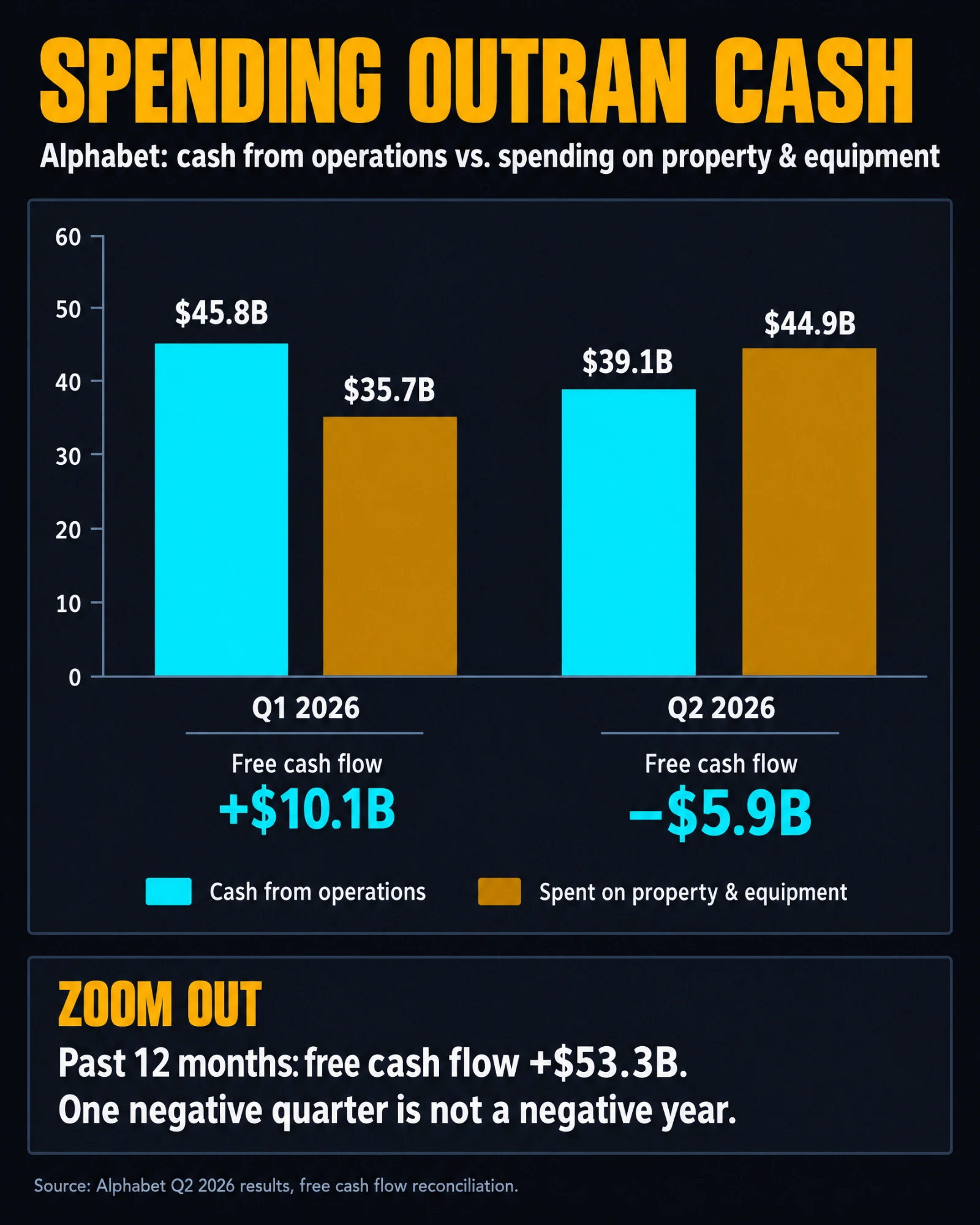
Over the past twelve months, free cash flow was still positive: $53.273 billion. Verified One negative quarter is not a negative year. These are also company-wide numbers: the filing doesn't separate out how much of the spending is for AI. Same reconciliation ↗
That's why the period matters. "Alphabet's cash flow turned negative" is true. Leave out the word "quarter" and it tells a much darker story than the filing does.
$496 billion of promises
Amazon reports a number most people never look at: the commitments customers have signed for future services, on contracts originally longer than a year, mostly for AWS. Verified
At the end of 2025 it stood at $244 billion. By March 31, $364 billion. By June 30, $496 billion. That's more than double in six months ($496B ÷ $244B ≈ 2.03). Estimated Year-end filing ↗ March ↗ June ↗
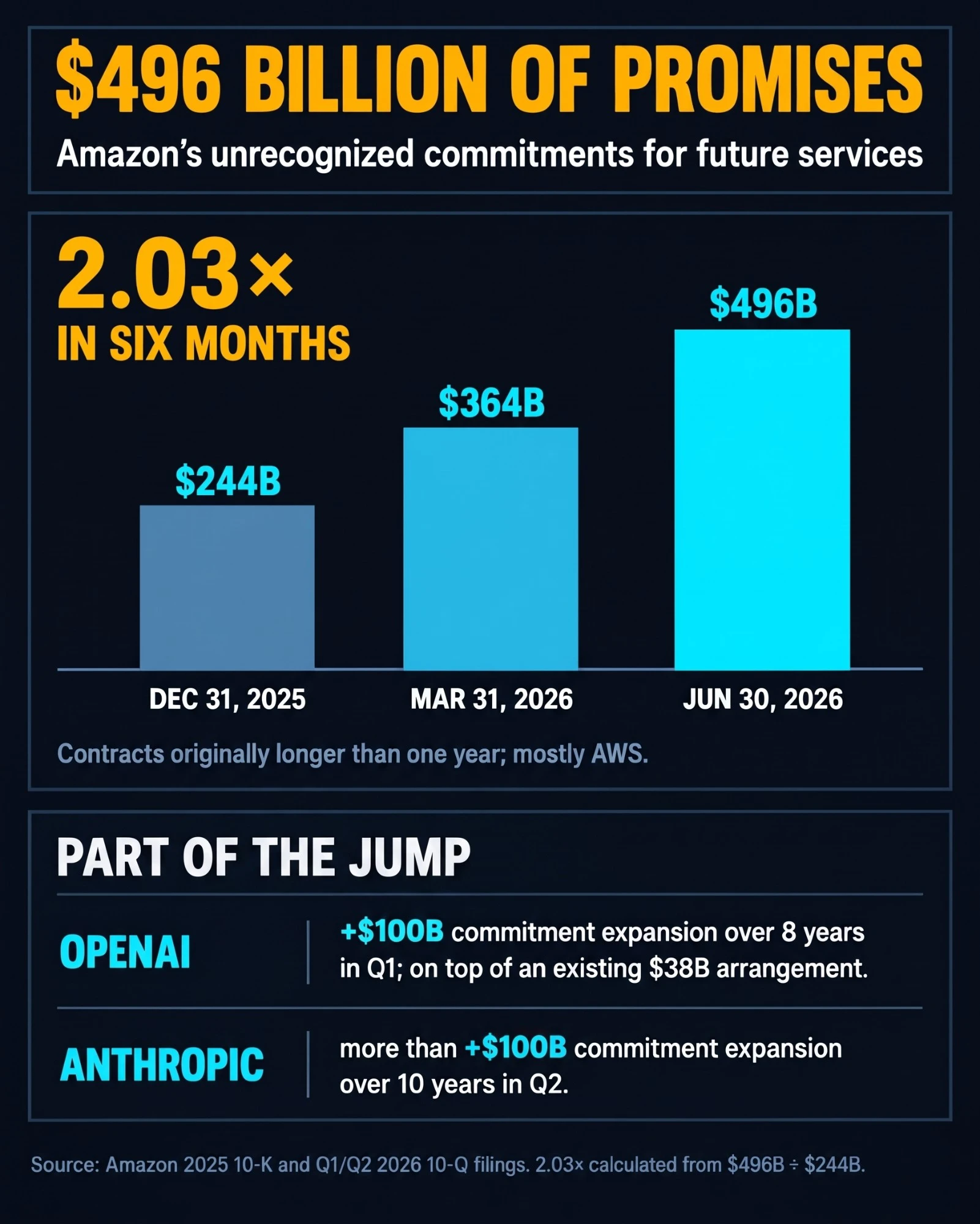
Two very large customers explain part of the jump. The June filing describes OpenAI expanding its commitment in the first quarter by $100 billion over eight years, on top of an existing $38 billion arrangement, and Anthropic expanding in the second quarter by more than $100 billion over ten years. Verified Note 1 ↗
These are contract commitments, not completed sales. Amazon recognizes the revenue only as the services are used and delivered. And the filing doesn't give a full bridge showing which customers account for every dollar of the growth.
A promise to buy and money already collected are different things. A big order book answers the first question. It doesn't answer the second.
Investors asked BCRED to buy back 191.8 million shares. It took about half.
BCRED is a broad private-credit fund. Every quarter it holds a "tender": a scheduled chance for investors to ask the fund to buy back their shares. In the second-quarter round, investors asked to sell 191,782,834 shares. The fund accepted 93,100,272: 48.54% filled, 51.46% not. Estimated Verified Final results, filed August 4 ↗
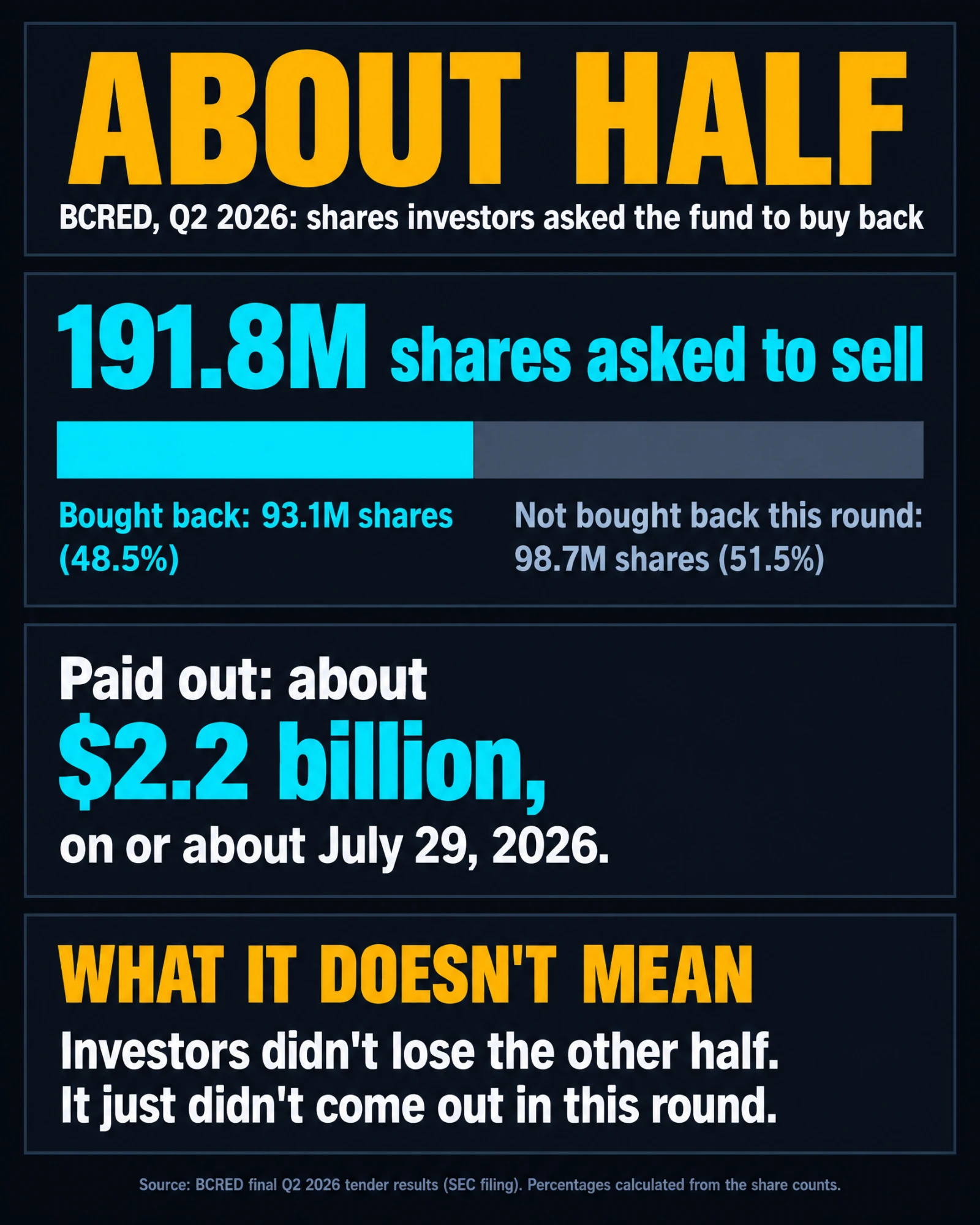
That was a real limit on withdrawals, not a rule that might someday apply. The fund paid out roughly $2.201 billion on or about July 29, after the early-repurchase deduction where it applied. Verified Payment details ↗
Investors didn't lose the half that wasn't bought back. It just didn't come out in this round. And because BCRED lends across many industries, this result is not proof of losses on AI loans.
The next round is already underway. In a September 3 update, BCRED estimated third-quarter requests at about $4.3 billion, roughly 10% of shares outstanding, and said it would fulfill requests representing 5%. Reported Those are preliminary. The final dollars come in November, and an unfinished record doesn't cancel the completed second-quarter shortfall. Q3 update ↗
Three customers, 72% of the business
CoreWeave sells AI computing capacity. In the second quarter of 2026 (April through June), its three largest customers accounted for 36%, 26% and 10%. Together that's 72%, leaving 28% for everyone else. Estimated Verified Customer disclosure ↗
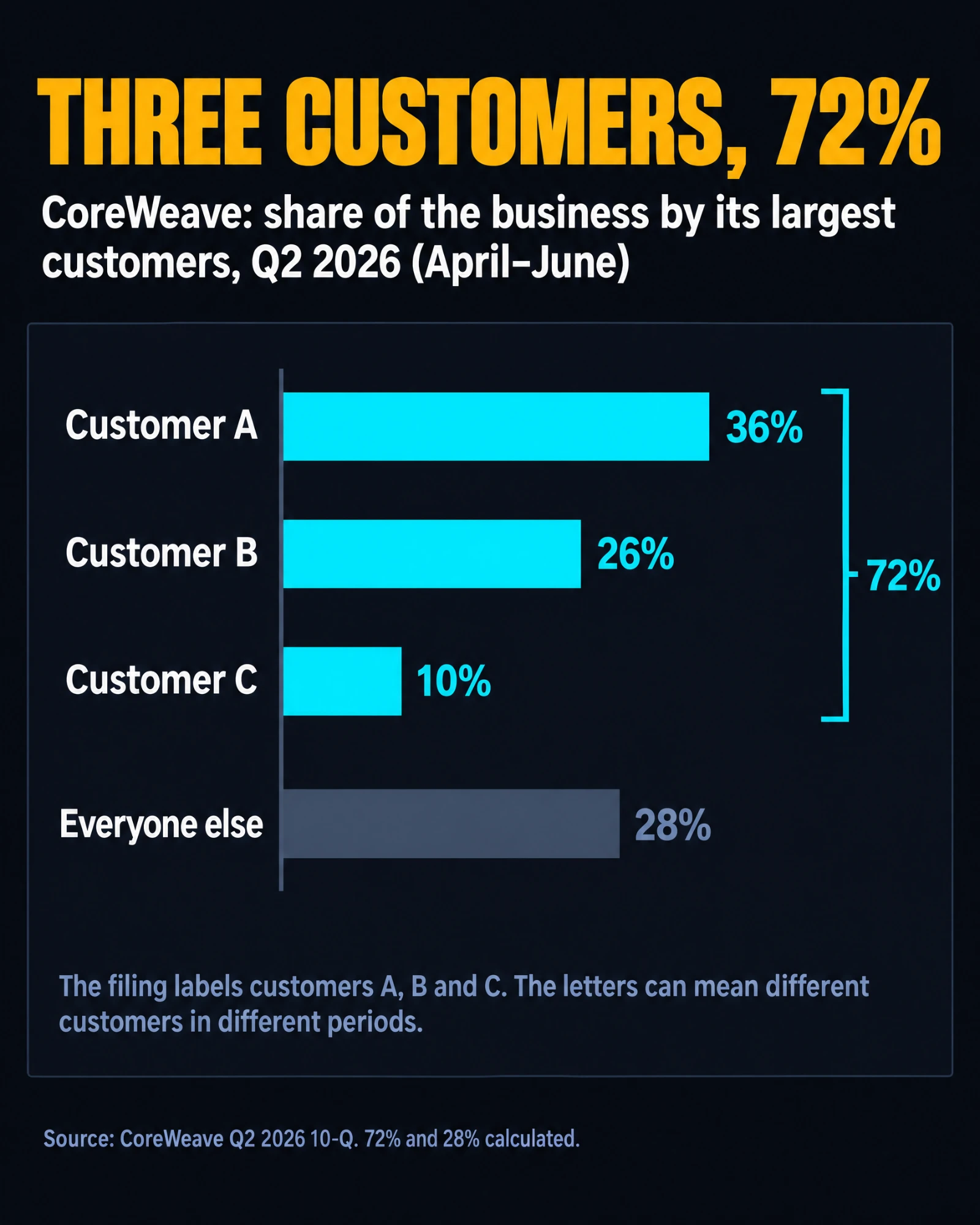
The filing labels them A, B and C, and warns that the letters can refer to different customers in different periods. So we don't attach company names to them.
NVIDIA's two buckets
NVIDIA turns up on both sides of these deals. Two numbers from the same filing look alike but aren't.
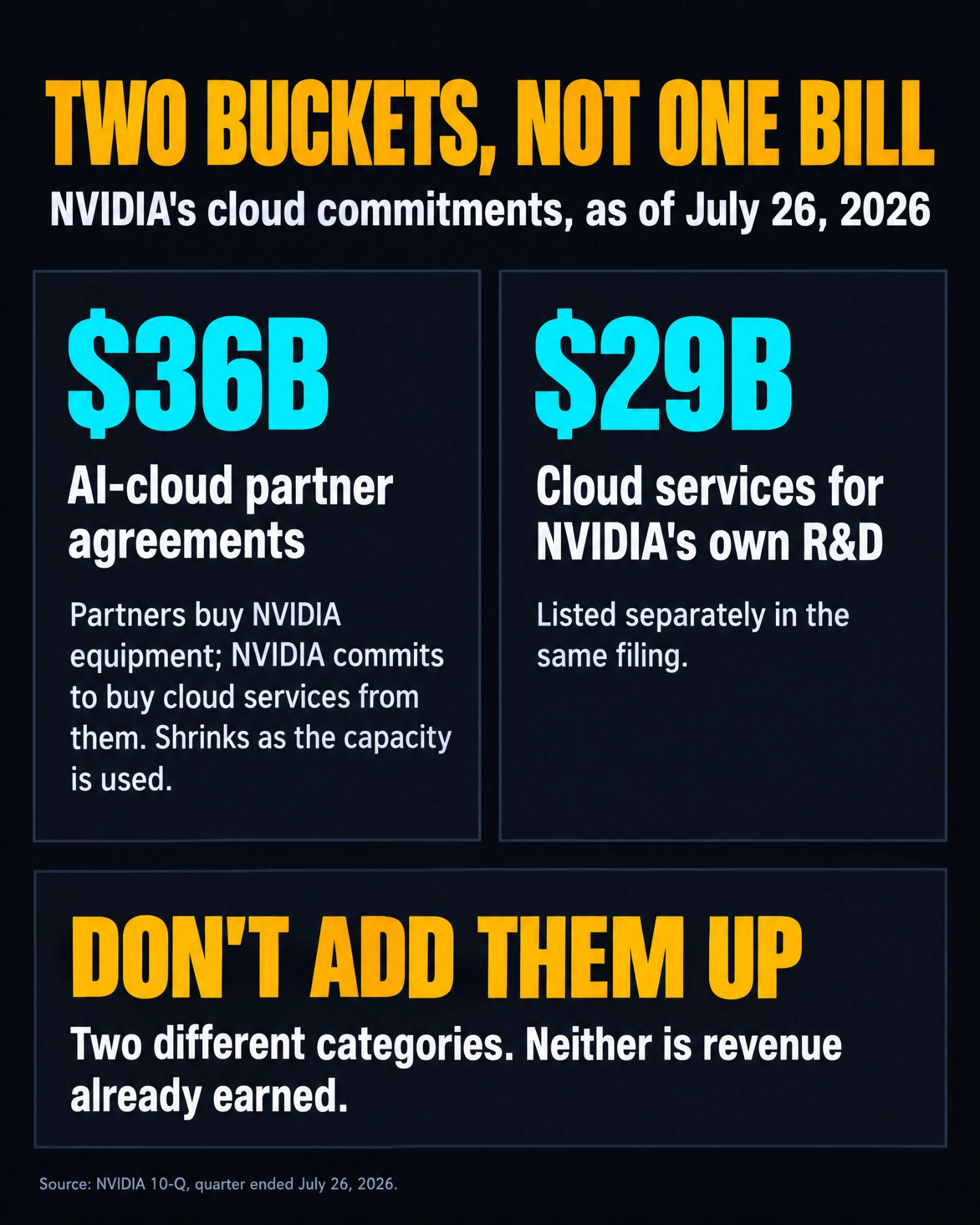
As of July 26, NVIDIA reported $36 billion in AI-cloud partner agreements: partners buy NVIDIA's equipment, and NVIDIA commits to buy cloud services from them, a commitment that shrinks as that capacity is used, by third parties or by NVIDIA's own research. Separately, it lists $29 billion in cloud-service agreements for its own research and development. Verified
Sources: MD&A and Note 10 ↗ Note 10 ↗
Two different categories, not two estimates of the same bill, and neither is revenue already earned. Switch between them from one quarter to the next and you can manufacture a trend that isn't there.
A contract for capacity isn't a permit to build it
Every number so far assumes the buildings actually get built. That takes power, water and permission, and in 2026 states started saying "not yet".
New York: a moratorium bill, then an order instead
- June 4, 2026Bill A11560 passes both houses Verified
The "responsible data center development act" would:
- stop state permits for large data centers (20 megawatts or more) for one year;
- order a state report on their electricity use and the water their cooling loses to evaporation;
- make utilities create a separate rate class for large data centers;
- set renewable-power targets, rising to 90% from 2040;
- require public hearings in host communities.
Its action list ends with "RETURNED TO ASSEMBLY": it was never delivered to the governor, signed or vetoed. Bill and actions ↗
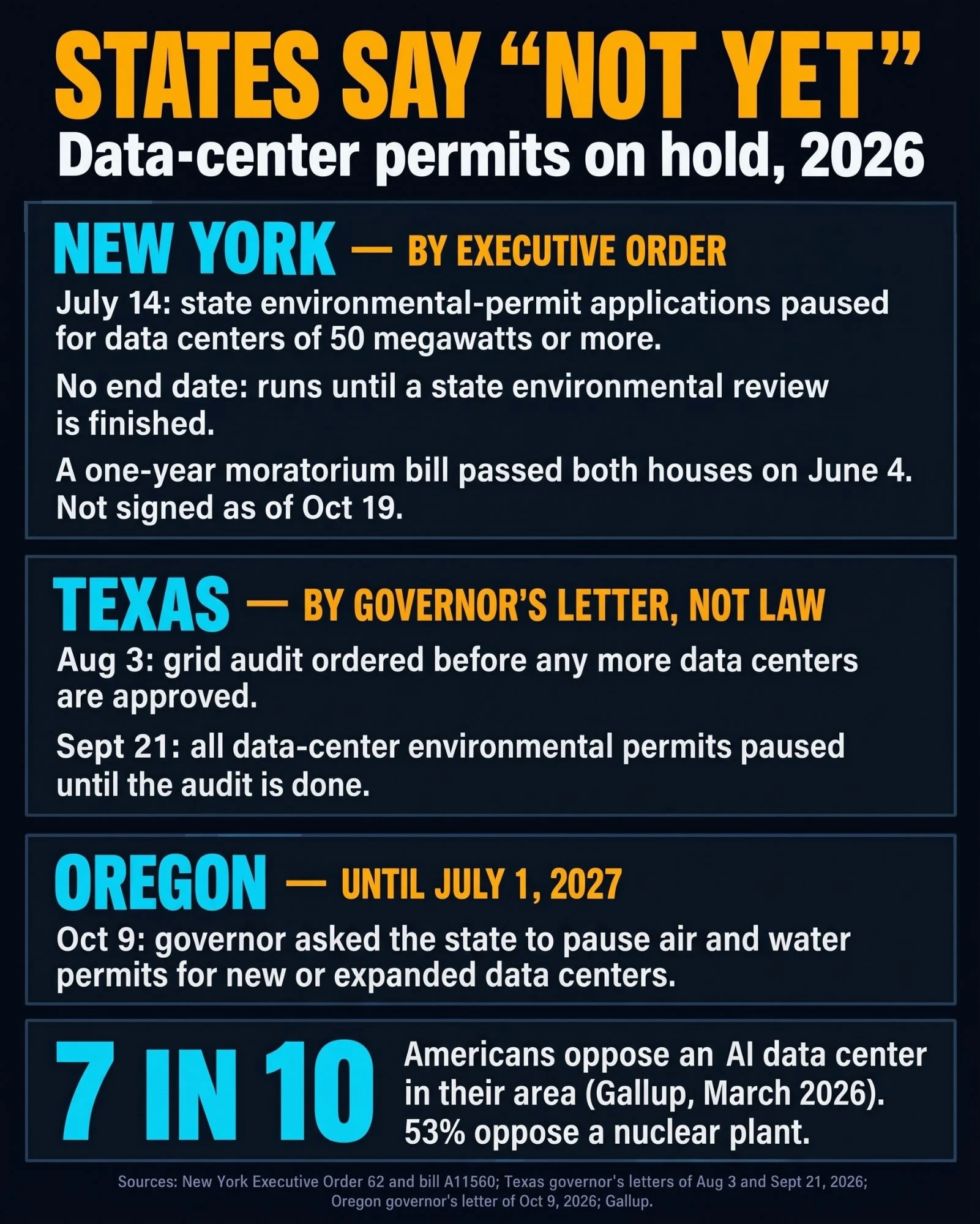
- July 14, 2026Executive Order 62 Verified
It covers data centers of 50 megawatts or more, with exclusions. It pauses state environmental-permit applications not already determined complete, until a specified environmental report and findings are done. Local-government permits are excluded from that provision. Order, sections 1 and 6 ↗ A law firm's client update describes the order as issued "instead of acting on the legislation." Reported Client update ↗
Texas: a pause by letter, not by law
Texas's pause comes from the governor's letters, not from a law. In order:
- June 20, 2025Senate Bill 6 signed Verified
Large loads (75 megawatts or more, unless the regulator sets a lower threshold) pay study fees and follow new grid-connection standards. Separately, large customers on the transmission grid that connect after 2025 must be able to be cut off in a grid emergency: they must "install equipment that allows the load to be curtailed during firm load shed." Bill analysis ↗ Signed June 20, 2025 ↗
- August 3, 2026The governor orders a grid audit Verified
The state's utility regulator and grid operator are to review the data centers waiting to connect "before any additional data centers are approved to move forward." Governor's letter ↗
- September 21, 2026Environmental permits paused Verified
The state environmental agency is told to "pause the issuance of all permits related to data center projects until ERCOT completes its review." Governor's letter ↗
Oregon: a pause requested until mid-2027
On October 9, 2026, Oregon's governor asked the state environmental agency to "pause processing and issuance of air or water discharge permit applications until July 1, 2027" for new or expanded data centers. Verified Governor's letter ↗
And closer to home
The pushback isn't only in state capitals. Data Center Watch, a tracker of local opposition, counted at least 75 projects, about $130 billion, blocked or delayed in the first quarter of 2026, and at least 45 projects, $68 billion, in the second. Reported Its totals combine "blocked" with "delayed", so they are not lost investment. Q1 2026 ↗ Q2 2026 ↗
Gallup, March 2–18, 2026, 1,000 U.S. adults; 48% strongly oppose. For comparison, 53% oppose a nuclear plant in their area. Verified Gallup ↗
None of the state pauses has a fixed end date except Oregon's requested one, and none of the documents says a particular facility has been canceled. "Blocked or delayed" is not "lost." We don't assign end dates or name casualties; we'll report what changes.
What we're watching next
These dates add appointments to the watchlist. They aren't new evidence by themselves.
- Oct 28 · 4:30 p.m. ETAlphabet's third-quarter results call Verified Announcement ↗
Does the second-quarter cash gap close, or grow?
- Oct 30 · 11 a.m. ETDominion Energy's third-quarter call Verified Calendar ↗
- Nov 2 · 2 p.m. ETThe Fed's bank-lending survey Verified Fed calendar ↗
- Nov 18 · 2 p.m. ETMinutes of the Fed's October 27–28 meeting Verified Fed calendar ↗
- December · no date yetOracle Estimated Investor calendar ↗
A monitoring window, not an appointment. Oracle's investor-events page currently says "There are no events scheduled", so we don't treat December 14 as announced.
Ten things we track, every issue
"Change documented" means the named event is on the record, not that an investment is good or bad. "Not assessed" is a gap, not an all-clear.
| What we follow | Where this issue stands | Evidence |
|---|---|---|
| Cloud growth versus spending | Not assessed: the consecutive-quarter comparison is incomplete. | Verified source; comparison open |
| Spending plans | Change documented: Meta narrowed its annual spending range, raising the lower end from $125 billion to $130 billion. | Reported plan |
| Accounting assumptions | Awaiting filing confirmation of Microsoft's announced building-life change. | Reported change |
| Cash and funding | Change documented: Alphabet's Q2 free cash flow crossed below zero. | Verified |
| Fund withdrawals | Change documented: BCRED's completed Q2 offer was partly filled; Q3 remains provisional. | Verified Q2 · Reported Q3 |
| Loan quality | Not assessed: the comparable quarter-to-quarter fund panel is incomplete. | Verified source; comparison open |
| Private-credit defaults | No current comparison available in this issue. | Verified methodology; current rate not established |
| Bank lending conditions | Awaiting the November survey; no new tightening finding here. | Verified schedule |
| Memory production | Baseline: Micron says HBM4 entered volume production in fiscal 2026. | Verified disclosure |
| Permission to build | Baseline: state permit pauses in New York (order, no end date), Texas (governor's letters, pending an audit) and Oregon (governor's request, to July 1, 2027); New York's moratorium bill is unsigned. | Verified order · Verified bill status |
Contracts, cash, withdrawals, permits: each answers a different question. We keep them separate, and we keep the reporting period next to every number. Next month, we'll show you what moved.
Suggest a topic for The Dissection, or send a question or correction: hello@c13m.com
Sources
Sources cited in this issue: official documents first, then news coverage and trackers. Reporting cutoff: October 18, 2026 (section 05: October 19, 2026). Every link opens the original document in a new tab.
- Dominion Energy: Q3 2026 callinvestors.dominionenergy.com
- Federal Reserve: November 2026 calendarwww.federalreserve.gov
- BCRED: final Q2 tender resultswww.sec.gov
- BCRED: September 3 update (Q3, preliminary)www.sec.gov
- Amazon: 10-K for 2025www.sec.gov
- Amazon: 10-Q, Q1 2026www.sec.gov
- Amazon: 10-Q, Q2 2026www.sec.gov
- CoreWeave: 10-Q, Q2 2026www.sec.gov
- New York: bill A11560 actionswww.nysenate.gov
- New York: Executive Order 62www.governor.ny.gov
- Oracle: investor eventsinvestor.oracle.com
- Meta: Q2 2026 resultswww.sec.gov
- Microsoft: FY2026 Q4 earningswww.microsoft.com
- Ares Capital: Q2 2026 resultswww.sec.gov
- Fitch: U.S. private credit default rate methodologyassets.fitchratings.com
- Micron: 10-K for fiscal 2026www.sec.gov
- New York: bill A11560, text and actionswww.nysenate.gov
- Texas: SB 6 bill analysiscapitol.texas.gov
- Texas: SB 6 historycapitol.texas.gov
- Gallup: Americans oppose data centers in their areanews.gallup.com
News coverage and trackers
- Davis Polk client update on New York's orderwww.davispolk.com
- Data Center Watch: Q1 2026datacenterwatch.org
- Data Center Watch: Q2 2026datacenterwatch.org
- Tucson city council vote (local news)www.azfamily.com
- St. Charles one-year ban (local news)www.stlpr.org
- College Station land-sale vote (local news)www.kbtx.com
- San Marcos rezoning vote (local news)spectrumlocalnews.com